
MissionAdapted:SatelliteIntelligence
Compact multimodal AI for payload side satellite event triage, reduced downlink load, and ground-based operator support.
The Bottleneck Is Not Imagery. It Is Decision Latency.
Satellites already capture enormous volumes of Earth observation data. The challenge is that raw data must often be downlinked, processed, reviewed, and interpreted on the ground before it becomes actionable. In time sensitive missions, that delay becomes operational risk.
Data Volume
Satellites capture more imagery and metadata than limited downlink windows can efficiently transmit.
Space Hardware Constraints
Onboard processors operate under strict memory, power, thermal, and radiation constraints.
Delayed Intelligence
Raw imagery creates delayed human analysis, slower alerts, and missed time sensitive events.
Reliability Risk
Generic AI systems are not designed for radiation-induced faults, memory corruption, or safe recovery.
Train Big on Ground. Fly Small in Orbit.
Large multimodal models are trained and evaluated on the ground. Only compressed, task-specific intelligence is deployed onboard as a payload-side module. The satellite filters events in orbit, transmits compact alerts, and the ground LLM copilot converts them into operator ready intelligence.
Train large multimodal models
Use satellite imagery, metadata, historical mission events, and operator feedback to ground train and evaluate large multimodal models.
Deploy compact task-specific intelligence
Run quantized models and LoRA mission adapters on payload side compute, isolated from the satellite bus.
Transmit intelligence, not raw overload
Send alerts, embeddings, thumbnails, and metadata. Operators get triage ready signal instead of full raw downlink.
Onboard AI Architecture
The AI layer runs only on the satellite payload side. It detects, prioritizes, and compresses then a ground side LLM copilot prepares human verifiable summaries before any operational escalation.
Payload side intelligence only. No direct control of safety critical satellite bus systems.
Sensor Data
Optical, thermal, multispectral, SAR, or mission specific payload inputs.
Preprocessing
Frame cleanup, calibration, tiling, metadata alignment, timestamping, and geolocation.
Onboard Encoder
Compact vision or multimodal encoder optimized for low-memory inference.
Mission Adapter
LoRA / adapter based task specialization for fire, maritime, agriculture, or anomaly events.
Event Filter
Filters low value frames and prioritizes actionable events before downlink.
Secure Downlink
Transmits only alerts, embeddings, thumbnails, and metadata packets.
Ground LLM Copilot
Converts machine outputs into operator-readable summaries ground side only.
Operator Dashboard
Human validates the alert before any operational escalation.
Compact payload-side module
Rugged, radiation-shielded compute. Hosts the quantized model and mission adapters. Bus-isolated.
Built for Low Bandwidth, Low Memory Fault Isolated Satellite AI
Onboard Event Triage
Detect clouds, fires, vessels, infrastructure changes, or target events before full downlink.
Adaptive Finetuning
Mission specific LoRA modules can be updated from the ground without replacing the full model.
Multimodal Copilot
Fuses imagery, telemetry, timestamps, and geospatial metadata into richer ground side analysis.
Embedded Compression
Sends key embeddings, alerts, thumbnails, and metadata instead of full raw imagery.
Payload first Safety
AI runs inside the payload layer. Failures are isolated from satellite bus control.
Audit Ready Output
Every inference includes model version, confidence, input trace, and operator review path.
Compact intelligence for constrained compute, reliable downlink, and operator assurance.
Space AI Must Be Fault-Aware
Space radiation can flip memory bits, corrupt computations, trigger processor faults, or force systems into safe recovery. For onboard AI, the model must be compressed, verifiable, and recoverable.
Single Event Upset
A high energy particle flips a bit in memory or logic, potentially corrupting weights, activations, or system state.
Single Event Latch up
A particle triggers abnormal current flow that can damage electronics if not quickly shut down.
Total Ionizing Dose
Longterm radiation exposure gradually degrades semiconductor behavior over the mission lifetime.
Watchdog Recovery
If the system behaves unpredictably, onboard software may reset, reboot, or enter a minimal safe state.
Reliability Response
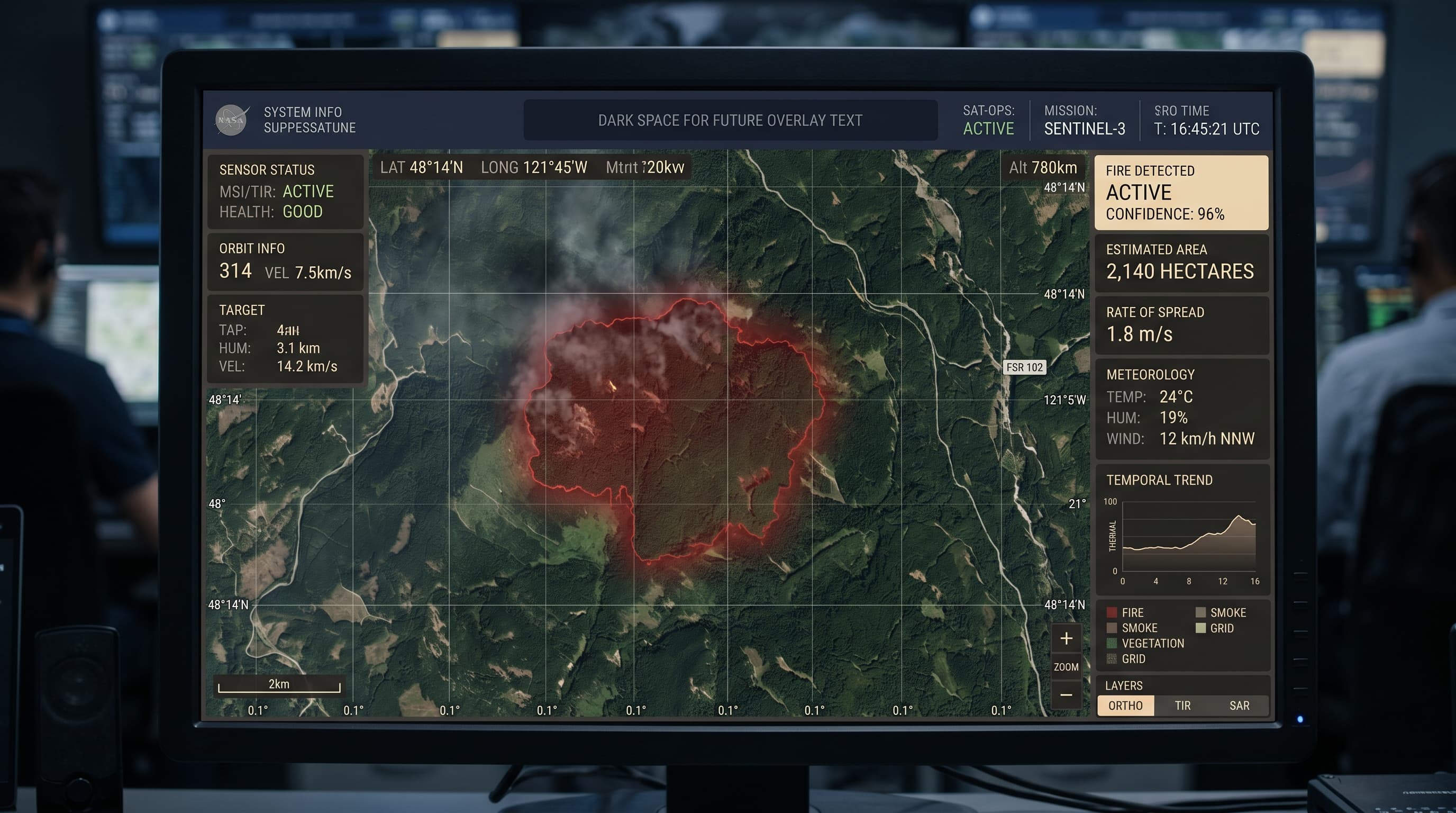
Pilot Use Case: Realtime Forest Fire Alert
A satellite detects thermal anomalies before full image downlink. The onboard AI filters irrelevant frames, sends compressed evidence packets, and the ground LLM copilot generates an operator readable alert summary.
Historical Data Simulation
StageHardware in the loop Testing
StagePayload side Sandbox Deployment
StageShort In orbit Trial
StagePartner Mission Integration
TargetOperational Flow
Capture thermal / optical frames
Filter clouds and irrelevant frames
Detect thermal anomaly
Send compressed alert packet
Generate groundside operator summary
Human validates before escalation
Success Metrics
Detection recall
Target ≥ 0.92
False positive rate
Target ≤ 5%
Downlink reduction
Target ≥ 70%
Alert latency
Target < 90s
Stable operation
Under test envelope
Operator verification
100% of escalations
Where Disobedient Geometry Fits
Most solutions focus on either ground analytics, satellite hardware, or onboard computer vision. Disobedient Geometry sits between these layers: compressed multimodal intelligence, payload side safety, and ground LLM operator support.
DG · You are here
Mission-specific
Onboard + Ground
Category
Ground Analytics Providers
Offering
Process satellite data after downlink
Limitation
Slow for time-critical events
DG Advantage
Pushes triage earlier into orbit
Category
Onboard CV Solutions
Offering
Detect specific objects or events onboard
Limitation
Narrow task coverage
DG Advantage
Adapter based mission tuning + ground LLM copilot
Category
Space Compute Vendors
Offering
Provide processors and rad hard hardware
Limitation
Hardware focused, not intelligence layer focused
DG Advantage
Runs optimized AI stack on available payload compute
Category
Large Aerospace Primes
Offering
Full mission systems
Limitation
Slow integration cycles
DG Advantage
Faster pilot driven integration layer
Category
Generic LLM Providers
Offering
Cloud-based reasoning
Limitation
Not designed for satellite constraints
DG Advantage
Compressed, payload-aware, audit ready architecture
DG is not competing with satellite hardware providers. It complements them by adding a deployable intelligence layer above payload compute and below ground operations.
Build the First Payload Side AI Pilot Together
Disobedient Geometry is seeking a satellite partner for archived data benchmarking, hardware in loop validation, and a narrow payload side in orbit demonstration.
Data Access
Archived EO datasets for model tuning, benchmark creation, and mission event labeling.
Hardware Validation
Compressed inference stack tested on payload class compute environments.
In Orbit Demonstration
Narrow event detection workflow deployed for a specific operational use case.
We are not replacing mission logic. We are making mission data actionable earlier.
Longterm path: joint roadmap toward qualified onboard AI modules.